Maybe your vet mentioned a soft murmur at a recent visit. Or you live with a Cavalier, Doberman, or Boxer and know the breed’s heart history. Either way, you want to support your dog’s heart now, and the two labels in front of you don’t make the choice easy.
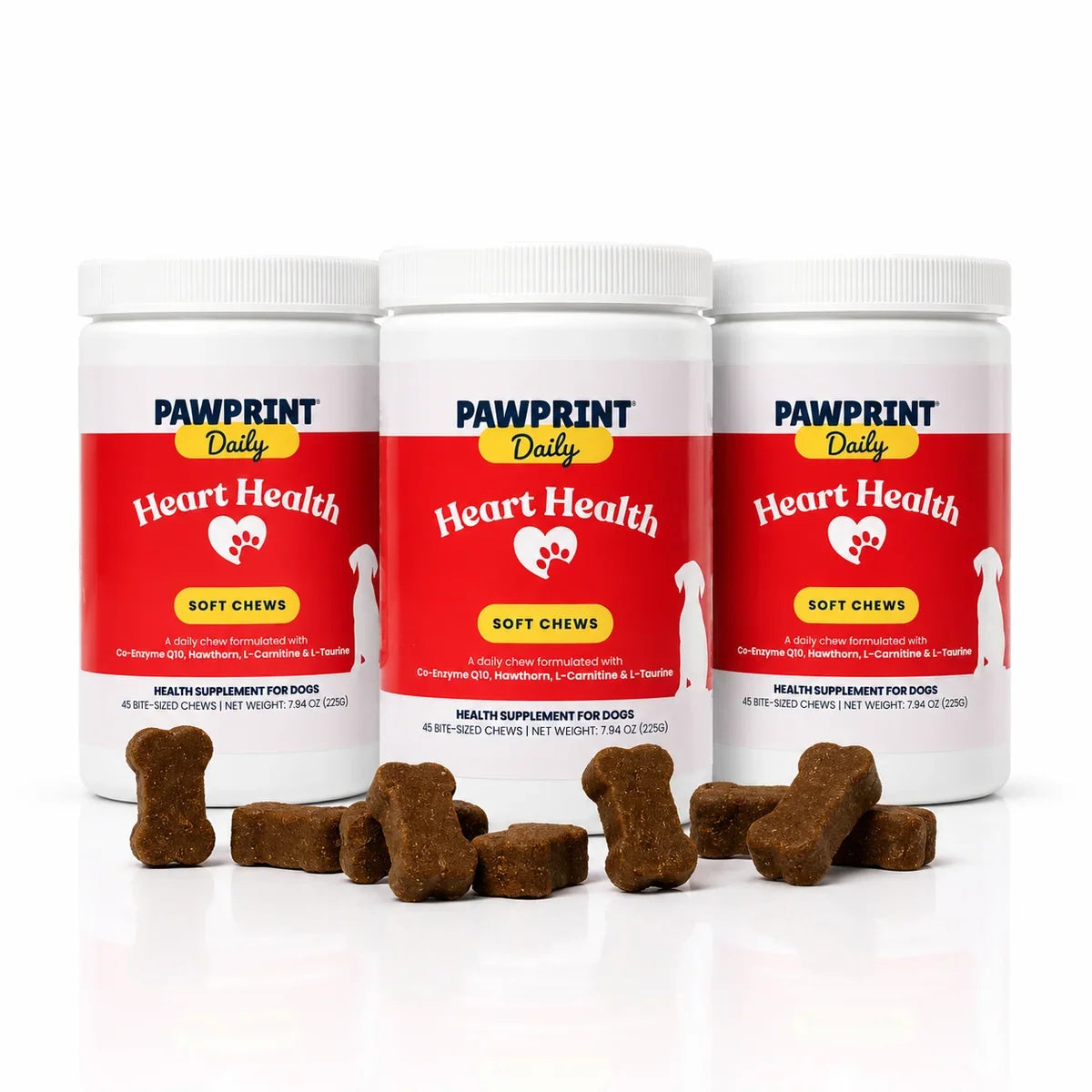
The Zesty Paws heart supplement is sold as Cardio Bites, with a separate Senior Advanced version. Cardio Bites and our Pawprint Daily Heart Health Soft Chew, from our pet supplements collection, are both nutritional supplements. Neither one is a medication for a murmur, mitral valve disease (MVD), dilated cardiomyopathy (DCM), or congestive heart failure (CHF).
Both build on taurine, L-carnitine, coenzyme Q10 (CoQ10), hawthorn berry, and L-arginine. They differ in how much of each the label discloses, in fish oil and berberine, in flavor, and in what you’ll pay per day.
⏱ 10-minute read | Updated November 2026 | Reviewed by Pawprint Oxygen Veterinary Team | Browse more articles →
Table of Contents
Cardio Bites vs Pawprint Heart Health Chews
Our label lists amounts per chew. The Cardio Bites label lists them per 2-chew serving (7 g), so the table keeps each brand’s own basis.
Factors |
Pawprint Daily Heart Health Soft Chews |
Zesty Paws Cardio Bites |
Taurine |
250 mg per chew |
In proprietary blend, amount not listed |
L-carnitine |
250 mg per chew |
In proprietary blend, amount not listed |
CoQ10 |
30 mg per chew |
In proprietary blend, amount not listed |
Hawthorn berry |
100 mg per chew |
In proprietary blend, amount not listed |
Proprietary blend total |
None |
1,140 mg per 2 chews |
L-arginine |
Included, amount not listed |
200 mg per 2 chews |
Omega-3 fish oil (EPA and DHA) |
None |
AlaskOmega fish oil, 150 mg per 2 chews |
Berberine |
Included, amount not listed |
None |
Vitamins |
Vitamins and minerals included, amounts not listed |
Folic acid (in blend); vitamin E 4 mg per 2 chews |
Flavor base |
Hydrolyzed chicken liver |
Salmon, with coconut glycerin, sweet potato, and tapioca |
Count and list price |
45 chews, $25 |
90 chews, $36.97 |
Quality seal |
None listed |
NASC Quality Seal |
Cardio Bites brings a few things ours doesn’t: fish oil, the NASC seal, skin-and-coat positioning, and wide availability at Chewy, Amazon, and Walmart. Our chew lists exact doses for its four main actives, adds berberine, and uses a chicken liver base for dogs who can’t have fish.
The National Animal Supplement Council awards its seal after auditing a supplier’s quality systems. That audit covers how the company makes and tracks its products. It doesn’t test whether a given formula supports heart function.

Listed Amounts vs a Proprietary Blend
In Cardio Bites, L-carnitine, taurine, hawthorn, CoQ10, and folic acid share one line on the label: 1,140 mg combined per 2 chews. The label doesn’t say how that total divides. Taurine could account for most of it or a small share.
Some retailer listings, including Chewy’s, show a per-ingredient breakdown that doesn’t appear on Zesty Paws’ own label. Those retailer figures aren’t consistent with each other, so the brand label is the safer reference.
Without a separate taurine or L-carnitine figure, you can’t work out how much of either your dog gets per pound of body weight, whether she weighs 20 lb or 80 lb.
Our Pawprint Daily Heart Health Soft Chews list milligrams for taurine, L-carnitine, hawthorn berry, and CoQ10. The L-arginine, berberine, and vitamins and minerals in the same chew appear without amounts, so for us the math also stops at four ingredients.
We formulated these chews to support healthy cardiovascular function, normal heart muscle function, and healthy circulation. Like any supplement, they go alongside the care your vet prescribes and never replace a medication.
Numbers matter most for a dog who already takes heart medication or another supplement with taurine or L-carnitine. With milligrams on the label, your vet can check what overlaps with her current routine and judge her total daily intake of those ingredients.
Dosing by Dog Size
Our chews are dosed at 1 chew per 30 lb of body weight each day, and dogs under 30 lb get half a chew. When your dog needs more than one chew, split the amount between morning and evening.
Cardio Bites uses three weight bands: 1 chew a day up to 25 lb, 2 chews for 26 to 75 lb, and 3 chews over 75 lb. Zesty Paws suggests beginning with half the recommended amount and working up, and its chews can also be split between morning and evening.
Here’s what each brand provides per day at five weights that land on both serving guides:
Dog weight |
Pawprint chews |
Taurine |
L-carnitine |
Hawthorn |
CoQ10 |
Cardio Bites chews |
Cardio Bites blend total |
Cardio Bites fish oil |
10 lb |
½ |
125 mg |
125 mg |
50 mg |
15 mg |
1 |
570 mg |
75 mg |
25 lb |
½ |
125 mg |
125 mg |
50 mg |
15 mg |
1 |
570 mg |
75 mg |
30 lb |
1 |
250 mg |
250 mg |
100 mg |
30 mg |
2 |
1,140 mg |
150 mg |
60 lb |
2 |
500 mg |
500 mg |
200 mg |
60 mg |
2 |
1,140 mg |
150 mg |
90 lb |
3 |
750 mg |
750 mg |
300 mg |
90 mg |
3 |
1,710 mg |
225 mg |
If your dog’s weight falls between these rows, check the serving guide on the product page or ask your vet for the right amount.
For a toy breed, our chew breaks in half by hand, so a 10 lb Chihuahua gets half a chew. Neither guide scales between 10 and 25 lb: a 10 lb dog and a 25 lb dog get the same amount from both brands, half of our chew or one Cardio Bites chew.
The guides split for large dogs. Cardio Bites holds at 3 chews a day for every dog over 75 lb, while ours keeps adding a chew for each 30 lb, so a 120 lb dog would take 4.
What Each Chew Costs Per Day
At list price, our 45-chew bottle comes to about $0.56 per chew, and a 90-chew bottle of Cardio Bites comes to about $0.41 per chew. Daily cost depends on how many chews your dog’s weight calls for.
Dog weight |
Pawprint cost per day |
Pawprint days per bottle |
Cardio Bites cost per day |
Cardio Bites days per bottle |
10 to 25 lb |
about $0.28 |
90 |
about $0.41 |
90 |
30 lb |
about $0.56 |
45 |
about $0.82 |
45 |
60 lb |
about $1.11 |
about 22 |
about $0.82 |
45 |
90 lb |
about $1.67 |
15 |
about $1.23 |
30 |
Our chews cost less per day for dogs up to 30 lb. At 60 lb and above, Cardio Bites costs less per day.
Daily cost tells you what you spend on chews. It can’t show what you spend per milligram of a given ingredient.
For a 60 lb dog, our chews run about $1.11 a day for 500 mg each of taurine and L-carnitine. Cardio Bites runs about $0.82 a day for the same dog, and the label doesn’t say how much of either those 2 chews contain.
Both brands offer ways to bring the bottle price down. We sell our chews in 1-, 2-, 4-, and 6-packs and by subscription, and Zesty Paws runs a subscribe-and-save program. Prices change often, so check both on the day you order.


Where the Two Formulas Differ
1) Fish Oil in Cardio Bites
Cardio Bites contains AlaskOmega fish oil, a source of the omega-3 fatty acids EPA and DHA. Ours contains none. For dogs with heart disease, omega-3s have some of the more direct research behind them of any ingredient in either chew.
In a small randomized, placebo-controlled trial of fish oil in 28 dogs with heart failure caused by DCM, eight weeks of supplementation reduced cardiac cachexia (loss of muscle mass) and lowered the inflammatory marker IL-1. Those dogs were already in heart failure, so the results don’t describe what fish oil does for a healthy heart.
The amounts also differ. The trial dose worked out to roughly 900 mg of combined EPA and DHA for a 44 lb (20 kg) dog. Two Cardio Bites provide 150 mg of fish oil in total, and the label doesn’t say how much of that is EPA and DHA.
If your dog gets no other omega-3, the fish oil is a point in Cardio Bites’ favor. If she already takes a fish oil supplement, the two overlap, and your vet should look at the combined amount. A dog on blood thinners needs a vet check before any fish oil is added.
2) Berberine in Our Chew
Berberine is a plant compound included in our formula. Studies of its effects on heart rhythm and circulation come mostly from human and lab research, with little data in dogs. Our label lists berberine without an amount.
In a 2-week study in healthy people, berberine slowed several liver enzymes (CYP2D6, CYP2C9, and CYP3A4) that process many medications. If your dog takes any cardiac drug, have your vet review the label before you start our chews.
3) Hawthorn and L-Arginine in Both
Hawthorn berry is a traditional botanical that contains antioxidants and has long been used for circulation. L-arginine is an amino acid the body uses to make nitric oxide, which helps blood vessels relax. Evidence for both in dogs is limited, and most of it comes from human and lab studies.
Each brand discloses one of these two ingredients. Our label gives 100 mg of hawthorn per chew, and the Cardio Bites label gives 200 mg of L-arginine per 2 chews.
4) Chicken Liver or Salmon
If your dog is on a food trial or has a known protein sensitivity, the flavor base may decide this for you.
Our chews use hydrolyzed chicken liver, while Cardio Bites uses salmon alongside its fish oil. That makes ours the one to consider for a dog who can’t have fish, and Cardio Bites the one for a dog who reacts to chicken.
Both come as palatable soft chews, which helps with picky eaters. Ours also breaks apart by hand, so a half dose tucks easily into a meal.
Zesty Paws Senior Advanced Cardio Bites
Zesty Paws also sells Senior Advanced Cardio Bites at $46.97 for 90 chews, and its product page lists an amount for every ingredient. That page doesn’t say whether those amounts are per chew or per 2-chew serving, so check the jar before you compare doses.
The listed amounts include 500 mg each of taurine, L-carnitine, and fish oil, plus 300 mg hawthorn, 200 mg L-arginine, 200 mg pumpkin seed, and 100 mg sea buckthorn (SeabuPure). It also contains 60 mg CoQ10, 20 mg vitamin E, and 0.5 mg folic acid.
With every amount disclosed and more fish oil than the original Cardio Bites, the senior version can be compared directly against our chews once you confirm its serving size. At 60 lb, for example, our chews provide 500 mg each of taurine and L-carnitine, 200 mg hawthorn, and 60 mg CoQ10.

What Each Ingredient Does for a Dog’s Heart
Taurine is an amino acid that heart muscle depends on. Low taurine has been linked to DCM in some dogs, including some American Cocker Spaniels and Golden Retrievers. A June 2026 Tufts update ties diet-associated DCM to diets high in pulses, grain-free or grain-inclusive, and says it doesn’t appear to be caused by low taurine.
Whole-blood and plasma taurine tests show whether a dog runs low. Our guide to taurine for dogs explains who’s most likely to need it.
L-carnitine moves fatty acids into heart muscle cells so they can be used for energy. True deficiency is rare, but vets sometimes look at it in DCM cases in breeds such as Boxers and Cocker Spaniels. More detail is in our post on L-carnitine for dogs.
CoQ10 helps cells produce energy and acts as an antioxidant.
In a 2022 randomized, placebo-controlled trial, 43 small and medium dogs with mitral valve disease, all on standard heart medication, took 200 mg of CoQ10 a day for three months. Their echocardiogram measurements and oxidative stress markers didn’t improve compared with placebo.
In the dogs already in heart failure, the CoQ10 group did show shifts in white blood cell counts that the researchers read as a possible anti-inflammatory effect. That finding is early and needs larger studies to confirm.
Those dogs already had diagnosed heart disease, and the dose was far higher than either chew provides. The result doesn’t tell us how CoQ10 works in healthy dogs or at the amounts in these chews. Our post on CoQ10 for dogs covers that research in more depth.
Among the ingredients in these chews, omega-3 fatty acids have the clearest support in dogs with heart failure, from the muscle-loss research described above. For hawthorn, L-arginine, and berberine, most of what’s known comes from human or lab studies.
Neither formula has been studied as a finished product. The available research looks at single ingredients, usually at different doses and in dogs with different health histories than yours.

Which Chew Fits Your Dog
You don’t have to wait for a problem to start supporting your dog’s heart. If she’s healthy, or her breed makes heart health a concern, a supplement can be part of the routine care you plan with your vet around her age, breed, and health history.
Start a baseline habit this week: count her breaths for 30 seconds while she sleeps and double it. Knowing her normal sleeping breathing rate makes a change easier to spot. Then match the chew to her situation:
Healthy adult, senior, or at-risk breed, and you want to know the milligrams: our chews list amounts for taurine, L-carnitine, hawthorn, and CoQ10.
No other omega-3 source in her diet: Cardio Bites includes fish oil.
Sensitive to fish: our chicken liver chew. Sensitive to chicken: Cardio Bites.
Up to 30 lb, with daily cost as the deciding factor: our chews cost less per day.
60 lb or more, with daily cost as the deciding factor: Cardio Bites costs less per day.
Diagnosed heart disease and on pimobendan, a diuretic such as furosemide, or an ACE inhibitor: start either chew only after your vet reviews the label, and keep giving every prescribed medication exactly as directed.
Start With the Diagnosis
If your vet has already heard a murmur, its grade and cause guide your dog’s care plan, and your vet may want an echocardiogram before you add anything. Our posts on what your dog’s heart murmur grade means and mitral valve disease in dogs explain how vets stage those findings.
Signs That Need Your Vet Now
Call your veterinarian right away if you notice any of these:
A resting or sleeping breathing rate consistently above 30 breaths per minute
Coughing at night
Fainting or collapse
A swollen belly
If your dog is struggling to breathe or collapses, go to the nearest emergency vet. Our list of signs of heart disease in dogs and cats covers more changes to watch for.

Questions to Ask Your Vet Before You Choose
Take the bottle, or a photo of the label, to your next appointment and ask:
Should my dog have whole-blood and plasma taurine tests first, given her breed and diet?
Does either chew overlap with her current medications or multivitamin? Our chews include vitamins and minerals, and Cardio Bites includes folic acid and vitamin E.
What starting amount fits her weight, and should I split it between morning and evening?
How will we track her heart over time: a recheck echocardiogram, her sleeping breathing rate at home, or both?
Choosing a Heart Chew for Your Dog’s Size and Diet
Whichever chew you choose, show your vet the label, ask whether a taurine test makes sense for her breed and diet, and start counting her sleeping breaths this week so you’ll notice if the number climbs.
Keep Reading
- Fera Pets Cardiac Support vs Pawprint Heart Health Soft Chews: Doses, Cost and Format
- L-Carnitine for Dogs: What It Does and When Your Vet May Recommend It
- CoQ10 for Dogs: What It Does and What the Heart Studies Found
- Find Pawprint Oxygen Products at Naturally Healthy Pets by Dr. Judy Morgan
- 5 Medical Items to Have On-hand for Pet Emergencies
- Top 5 Dog Foods for Congestive Heart Failure in Dogs
- Is Ham Bad for Dogs? Holiday Foods, Sodium, and Dogs With Heart Disease