
Senior Pets and Breathing Problems: A Guide to Aging Lungs, Hearts, and Airways
This guide walks you through why senior pets are prone to breathing trouble, how to spot the warning signs, and why a pet oxygen kit is one of the most practical safety nets you can have.
⏱ 9-minute read | Updated July 2026 | Reviewed by Pawprint Oxygen Veterinary Team | Browse more articles →
Table of Contents
If you share your home with an aging dog or cat, you've probably noticed the small changes that come with the years: a little more sleep, a little less spring in the step, the occasional cough. Most of those changes are normal. But there's one category of age-related change that every senior-pet owner should take seriously: how your pet breathes.
Respiratory problems are far more common in older animals than in young ones, and the conditions behind them tend to share a dangerous trait; they reduce the margin of safety your pet has when something goes wrong. A young, healthy dog can absorb a coughing fit or a bout of overexertion. A twelve-year-old dog with a collapsing trachea and a heart murmur often cannot.
This guide walks through why senior pets are so prone to breathing trouble, how to spot the warning signs early, and why a home pet oxygen kit like the Rescue Oxygen Kit is one of the most practical safety nets you can keep on hand for an aging animal.

Why Aging Bodies Struggle to Breathe
Breathing is the product of three systems working together: the airways that carry air in and out, the lungs that exchange oxygen and carbon dioxide, and the heart that pumps oxygenated blood through the body. Aging quietly chips away at all three.
In senior pets, the airways stiffen and weaken. Cartilage that once held the windpipe open can soften, and the small muscles that control the larynx can lose their function. The lungs lose elasticity, so each breath moves a little less air and clears a little less efficiently. And the heart, after years of work, frequently develops murmurs, valve disease, or enlargement that interferes with both circulation and the airways sitting right next to it.
The results are senior pets that may look perfectly fine at rest but have almost no reserve when demand spikes, like during exercise, on a hot day, in a moment of stress, or when a chronic condition suddenly flares. Understanding the specific conditions behind this helps you know what to watch for.
The Four Most Common Respiratory Conditions in Senior Pets
Veterinary references consistently identify a handful of conditions as the usual culprits behind breathing trouble in older animals. The most commonly encountered respiratory diseases in older pets are tracheal collapse, laryngeal paralysis, congestive heart failure, and chronic bronchitis, and several of these tend to travel together.
1. Tracheal collapse
Tracheal collapse happens when the cartilage rings supporting the windpipe weaken and flatten, narrowing the airway. It shows up most often in older small and toy breeds like Yorkshire Terriers, Chihuahuas, Pomeranians, and similar dogs. Its hallmark is a dry, honking cough that worsens with exercise, excitement, heat, humidity, and obesity. What makes it especially relevant for senior owners is how often it overlaps with other problems: up to 30% of dogs with tracheal collapse also have some degree of laryngeal paralysis, and a heart murmur is a common concurrent finding, partly because an enlarged heart can physically press on the windpipe.
2. Laryngeal paralysis
The larynx is the gateway to the airway, opening to let air in and closing to protect the lungs. In laryngeal paralysis, the nerves controlling it fail, and the airway can't open properly during a deep breath. It's a frequent cause of emergency visits in older large-breed dogs. Labradors and other big breeds are classic patients.
Classic signs of laryngeal paralysis include
- Noisy breathing
- A change in the sound of the bark
- Exercise intolerance
- Intolerance to extreme heat and stress when the dog's demand for air outstrips what the half-closed airway can deliver
3. Congestive heart failure
Heart disease and breathing problems are deeply intertwined in senior pets. As valve disease or an enlarged heart progresses to congestive heart failure, fluid backs up into the lungs, making it harder to oxygenate the blood. The earliest sign owners often notice is a rising resting respiratory rate (your pet breathing faster than normal while asleep) along with coughing, reluctance to exercise, and tiring quickly. This is one of the most important reasons to know your pet's normal resting breathing rate. More on this below.
4. Chronic bronchitis and asthma in cats
Older cats deserve their own mention. Feline asthma and chronic bronchitis become more significant with age, and cats are masters at hiding illness until they're in real trouble. Open-mouth breathing or panting in a cat is never normal and is always an emergency. By the time a cat resorts to open-mouth breathing or panting, the situation is already serious.
Knowing Your Pet's Baseline: The Single Most Useful Habit
The most valuable thing a senior-pet owner can do costs nothing: learn your pet's normal resting respiratory rate. While your dog or cat is calm and asleep, count the number of breaths (one inhale plus one exhale) over 30 seconds and double it. For most healthy dogs and cats at rest, that number falls under roughly 30 breaths per minute.
Track it occasionally over a few weeks so you know what's normal for your individual pet. A resting rate that climbs and stays elevated, especially in a pet with known heart disease, is one of the earliest and most reliable warning signs that something is wrong, often appearing before any dramatic symptoms. It's the home-monitoring equivalent of an early-warning radar, and it turns a vague "he seems off" into a specific number you can report to your vet.

Warning Signs: When to Watch, and When to Act
Because senior pets decline gradually, owners can normalize symptoms that actually deserve attention. Use these tiers to calibrate your response.
Worth a Non-Urgent Vet Visit:
|
Warning Signs:
|
True Emergency:
|
The line between the second and third tiers can be crossed in minutes, especially in a senior pet with more than one heart or lung condition. That's exactly the scenario a home oxygen kit is built for.
Why a Home Oxygen Kit Matters Most for Senior Pets
Here's the uncomfortable math of an aging animal: the conditions most common in senior pets, tracheal collapse, laryngeal paralysis, heart failure, are precisely the ones prone to sudden, frightening flare-ups. A collapsing-trachea dog can spiral into a coughing crisis. A laryngeal-paralysis patient can hit a respiratory wall on a warm afternoon. A heart-failure pet can decompensate over a single evening. And these episodes have a habit of striking at night or on weekends, when your regular vet is closed and the nearest ER may be 20 or 30 minutes away.
In a respiratory emergency, those minutes are the whole game. A pet whose oxygen saturation is falling doesn't have time to spare, and the drive to the hospital is often the most dangerous part. That's the gap the Rescue Oxygen Kit was designed to close.
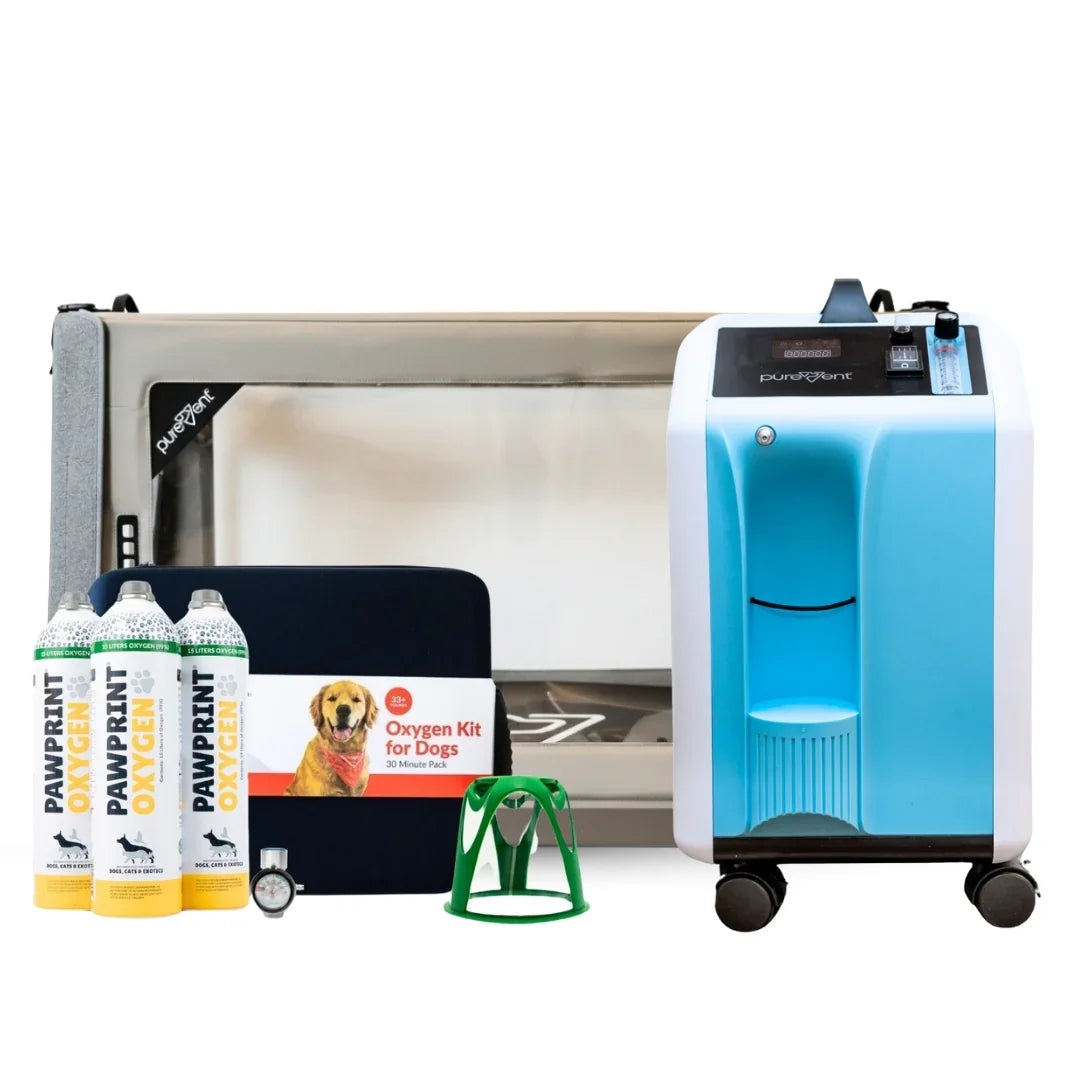
Each kit includes:
- Portable, pre-filled oxygen canisters (no prescription required, no medical training necessary)
- The PureVent™ pet oxygen mask, engineered with tri-vent technology that removes up to 80% more rebreathed carbon dioxide than standard masks, which is critical for a struggling senior pet that needs efficient, clean oxygen
- A pre-set flow regulator set to your pet's weight so you can ensure they are getting the right amount of oxygen every time
- Soft, flexible oxygen tubing
- A quick-start guide written for owners dealing with a stressful situation
Supplemental oxygen doesn't cure tracheal collapse or reverse heart disease. Those are managed with your veterinarian over time. What it does is buy your pet stability in the critical window between the onset of a crisis and arrival at professional care. Emergency veterinarians consistently report that pets who arrive already receiving oxygen tend to fare better than those who arrive blue-gummed and air-starved. For an older pet with little reserve, that bridge can be the difference between a scare and a tragedy.
For the full breakdown of what's in the kit and how it works, see our foundational guide: Introducing the Rescue Oxygen Kit: The At-Home Pet Oxygen Kit.

Building a Senior-Pet Respiratory Safety Plan
Preparation turns a panicked night into a managed one. If you have an aging dog or cat, put these pieces in place now.
1. Establish the baseline and the team:
- Learn and periodically log your pet's resting respiratory rate.
- Ask your vet, at your senior pet's next checkup, which respiratory conditions your individual pet is at risk for and what an emergency would look like for them specifically.
- Keep your regular vet's number and your nearest 24-hour emergency hospital's address saved and accessible.
2. Reduce the everyday triggers:
- Keep your pet at a healthy weight as obesity worsens nearly every senior respiratory condition.
- Use a harness instead of a neck collar for dogs prone to tracheal collapse.
- Avoid exertion in heat and humidity, the classic trigger for laryngeal-paralysis and tracheal-collapse crises.
- Keep air quality good at home by minimizing smoke, dust, and strong aerosols. This is especially important for cats with asthma.
3. Stage your emergency response:
- Keep a Rescue Oxygen Kit in a known, easy-to-reach spot, and make sure everyone in the household knows where it is and how to use it.
- Rehearse the steps mentally: check the gums, start oxygen, call the ER, transport calmly.

What to do if a breathing emergency hits:
- Stay calm and keep your pet calm. Stress increases oxygen demand.
- Check the gums. Pink is reassuring; pale, gray, or blue means oxygen, now.
- Start oxygen. Open your Rescue Oxygen Kit and put the PureVent mask near your pet's face. A gentle seal is better tolerated than a tight one.
- Call your emergency vet, and report the situation and that you're administering oxygen. Make sure to give your ETA, so the medical staff are ready for your arrival.
- Transport without delay, continuing oxygen in the car if you safely can do so.
Frequently Asked Questions
Is it normal for an older dog to breathe harder or cough more?
Some reduction in stamina is a normal part of aging, but a new or worsening cough, noisy breathing, or a rising resting respiratory rate is not something to wait out. These are common early signs of treatable conditions like tracheal collapse, laryngeal paralysis, or heart disease, and early veterinary attention leads to better outcomes.
What is a normal resting breathing rate for a senior dog or cat?
For most healthy dogs and cats at rest, the resting respiratory rate is under roughly 30 breaths per minute. Count breaths (one inhale plus exhale) for 30 seconds while your pet sleeps, then double it. A rate that climbs and stays elevated, especially above 40, warrants a prompt call to your vet, particularly in pets with known heart disease.
My senior cat is breathing with their mouth open. Is that an emergency?
Yes. Open-mouth breathing or panting in a cat is always a medical emergency. Cats hide illness extremely well, so by the time a cat is open-mouth breathing, they are usually in significant respiratory distress. Begin oxygen if you have it and get to an emergency vet immediately.
Can a home oxygen kit treat my pet's heart or airway condition?
No, and it isn't meant to. Conditions like congestive heart failure, tracheal collapse, and laryngeal paralysis are managed by your veterinarian with medication, lifestyle changes, and sometimes surgery. A Rescue Oxygen Kit is an emergency bridge: it provides supplemental oxygen to stabilize your pet during a crisis while you get to professional care.
Do I need a prescription or special training to use the Rescue Oxygen Kit?
No, the Rescue Oxygen Kit is a non-prescription, owner-administered kit designed for use by everyday pet owners in a stressful moment. The included quick-start guide walks you through how to use it, and the Pawprint Oxygen team is available for any questions.
My senior pet seems healthy. Is an oxygen kit really necessary?
Think of it the way you think of a smoke detector or fire extinguisher: you hope never to need it, but the cost of being without it in an emergency is severe. Senior pets are precisely the population most likely to experience a sudden respiratory crisis, often at night or on a weekend. Having a kit ready is preparation, not overkill.
Where can I get a Rescue Oxygen Kit?
Visit pawprintoxygen.com for full product details and to add a kit to your senior pet's care setup.
The Bottom Line
Our pets give us their best years, and the least we can do is be ready for the harder ones. Aging lungs, hearts, and airways leave senior dogs and cats with little room for error when a breathing emergency strikes, and those emergencies have a way of arriving at the worst possible time. Knowing your pet's baseline, recognizing the warning signs, and keeping a plan in place are what turn a frightening night into a survivable one.
The Rescue Oxygen Kit is vet-designed, trusted by 3,000+ U.S. fire departments, and built for the moment minutes matter most. For a household with an aging pet, it's one of the simplest, highest-value pieces of preparedness you can put in place today.
Get a Rescue Oxygen Kit for your senior pet → CLICK HERE
Related Reading
Keep building your pet emergency plan with these guides:
- Brachycephalic Breeds and Breathing Emergencies
- Fireworks Anxiety and Respiratory Distress