
Watching your dog crumple to the floor is frightening, and before anyone can talk about a diagnosis, you need a way to make sense of what you just saw.
Fainting and collapse look alarming, and they can point to something serious, but the details you notice in the next few minutes will shape everything that happens next.
This guide walks through how to tell a faint from a seizure or simple weakness, what the common causes are, what to do in the moment, and when an episode crosses into an emergency. Much of it comes down to observation.
The more precisely you can describe what happened, the faster your veterinarian can find the cause.
⏱ 10-minute read | Updated August 2026 | Reviewed by Pawprint Oxygen Veterinary Team | Browse more articles →
Table of Contents
What Fainting and Collapse Actually Mean
Fainting, known medically as syncope, is a brief loss of consciousness caused by a temporary drop in blood or oxygen flow to the brain.
Most dogs go limp, drop, and then come around on their own within seconds, often acting as if nothing happened.
Collapse is a broader term. It describes a sudden loss of postural strength, the inability to stay standing, which may or may not involve losing consciousness. A dog can collapse and stay fully awake, unable to rise.
The two overlap, but the distinction matters. A true faint involves that momentary loss of consciousness from reduced blood flow to the brain. A collapse without fainting keeps your dog aware even as their legs give out. Which one you witnessed points toward different underlying problems.
Both are symptoms, not diagnoses. That is the single most important thing to understand up front. Fainting tells you something interrupted your dog’s oxygen or blood supply to the brain for a moment. It does not tell you why.
Finding the why is the work that follows, and a companion guide on telling a seizure from a faint is a good next stop if you’re still sorting out what you saw.
Fainting vs. Seizure vs. Weakness: How to Tell
This is the question most owners are desperate to answer, and getting it right helps your vet enormously.
A faint, a seizure, and plain weakness look different once you know what to watch for. The table below lays out the differences side by side, and the notes underneath cover what each one tells you.
What you saw |
Faint (syncope) |
Seizure |
Weakness / collapse |
Onset |
Sudden |
Sudden |
Gradual or sudden |
Muscle activity |
Limp, floppy |
Stiff or paddling |
Can't bear weight, no rigidity |
Consciousness |
Briefly lost |
Lost |
Stays conscious |
Eyes |
Often open, pupils normal |
Open, pupils often dilated |
Open, alert |
Drooling / soiling |
No |
Common |
No |
Recovery |
Quick and complete, seconds |
Slow, minutes of disorientation |
No true "recovery," stays down |
Common triggers |
Exertion, excitement, coughing |
Often none |
Exertion, underlying illness |
Signs it was likely a faint (syncope)
Syncope is usually sudden and brief. Your dog goes limp, drops, and recovers quickly and completely, usually within seconds. The body stays floppy rather than stiff, the eyes often stay open, and the pupils do not dilate the way they do in a seizure.
Episodes are frequently tied to exertion, excitement, or a coughing fit. The recovery is the giveaway. After a faint, most dogs stand up and seem normal almost immediately.
Signs it was likely a seizure
A seizure looks different in almost every respect. Instead of going limp, the body often stiffens or the legs paddle. You may see drooling, and some dogs lose bladder or bowel control.
The clearest difference comes afterward. A seizure is usually followed by a period of disorientation that lasts minutes, sometimes longer, where your dog seems dazed, wobbly, or unlike themselves.
That post-episode confusion, called the post-ictal phase, is largely absent after a true faint.
Signs it was weakness or collapse without fainting
Sometimes a dog stays conscious the whole time but cannot rise or bear weight. This points away from both fainting and seizures and toward orthopedic, neuromuscular, or metabolic problems. The dog is aware, responsive, and simply unable to get up.
One request that helps more than almost anything else: film it if you can. Recovery detail matters more to your vet than the collapse itself, and a short video of how your dog looked during and just after the episode can shorten the diagnostic path considerably.
Common Causes of Fainting and Collapse in Dogs
Because fainting is a symptom, the causes span several body systems, both cardiac and non-cardiac. Organizing them by system makes it easier to match what you saw to your dog’s history and health.
1. Heart-related causes
Cardiac problems are among the most common reasons dogs faint. Arrhythmias, meaning an irregular heartbeat, structural heart disease, and anything that impairs the heart’s output can briefly starve the brain of blood.
These episodes are often triggered by exertion or excitement. Older dogs and certain breeds carry higher risk. Boxers and German Shepherds are prone to ventricular arrhythmias, and syncope becomes more common with age. This is also the category where a quick recovery should never be read as reassurance.
2. Respiratory and low-oxygen causes
When the lungs or airway cannot move enough oxygen into the blood, the brain can be shortchanged enough to trigger collapse. Collapsing trachea, laryngeal paralysis, pneumonia, and chronic airway disease all fit here. Flat-faced breeds are especially vulnerable because their anatomy already makes breathing harder.
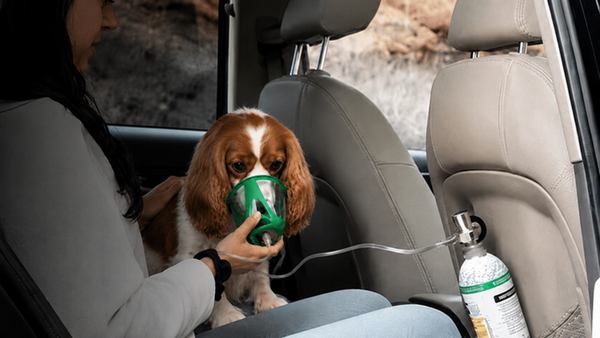
This is the narrow slice of fainting where supplemental oxygen enters the picture, and only under veterinary direction. For a dog with a diagnosed chronic respiratory condition, a veterinarian may recommend at-home oxygen support as part of a broader management plan.
Our at-home oxygen therapy equipment exists to serve exactly that vet-directed role: easing the work of breathing for a known condition, never fixing an acute faint. Oxygen buys time and reduces strain. It does not resolve the cause.
3. Neurologic causes
Seizure disorders and vestibular disease can produce episodes that look like fainting to an untrained eye. The differentiation section above is the place to sort these out, since the movement and recovery patterns usually tell them apart.
4. Metabolic and systemic causes
Several whole-body problems can drop a dog without warning. Low blood sugar (hypoglycemia), Addison’s disease, anemia, electrolyte imbalances, and dehydration all reduce the brain’s supply of what it needs to stay conscious. These causes are a reminder that not every faint is a heart problem.
5. Situational and reflex causes
Some faints are triggered by a specific action. A hard coughing fit can drop a dog with an airway problem, a pattern called cough-induced or situational syncope, commonly linked to collapsing trachea and laryngeal paralysis.
If your dog’s cough has a honking quality, our guide on whether that goose-like cough could be collapsed trachea is worth a read. Vasovagal episodes, overheating and heatstroke, and extreme stress or pain can all provoke a reflex faint as well.

What to Do the Moment Your Dog Collapses
When your dog goes down, a calm, ordered response helps both of you. Panic is understandable, but steady hands make a difference.
Start here:
Stay as calm as you can. Your dog reads your energy.
Keep them low and on their side, where blood flow to the brain is easiest.
Clear the mouth and check that they are breathing.
Note the time and how long the episode lasts. Duration is a key clinical detail.
Remove any trigger you can, whether that is heat, exertion, or a stressful situation.
Equally important is what to avoid. Do not forcibly restrain a dog who is coming around, since that can add stress.
Do not offer food or water while they are unconscious or groggy, which risks choking. And do not assume the episode was harmless simply because your dog seems fine now.
Recovery Timeline and What to Monitor
Most healthy dogs improve within one to three weeks, though seniors and dogs with other conditions can take longer. Knowing what a normal recovery looks like helps you catch the cases that are escalating.
Watch a few things daily. Track how often your dog coughs and whether the quality is changing, and keep an eye on appetite and energy. The single most useful metric is your dog's resting respiratory rate, which serves as an early warning sign when it starts to climb.
How to Count Resting Respiratory Rate
Counting is simple once your dog is settled:
Wait until your dog is calm or asleep.
Count each breath, one full inhale and exhale, over 30 to 60 seconds.
Compare the result to the normal range.
A normal resting rate for dogs falls roughly between 15 and 30 breaths per minute, and a consistent rate above 30 at rest is abnormal and warrants a call to your veterinarian.
If you want a step-by-step walkthrough, our guide on measuring your pet's respiratory rate covers the technique in detail.
A dog that is still coughing at the two-week mark but eating, drinking, and breathing normally is usually finishing a normal recovery. A cough paired with a rising respiratory rate, dropping appetite, or new lethargy is a different story and means it is time to check in with your veterinarian.
On the contagious side, keep your dog away from other dogs until your vet gives the all-clear, which is often a week or more after symptoms resolve.
Checking Breathing and Responsiveness
While you wait or prepare to travel, keep watching a few things. Note the effort your dog puts into each breath, whether it looks easy or labored.
Check the gum color. Pink is reassuring, while pale or bluish gums signal a lack of oxygen and a need for urgent care. Gauge how responsive your dog is to their name and to touch.
If Your Veterinarian Has Recommended Home Oxygen
This step applies only to dogs already on a vet-directed oxygen plan for a known condition. If that describes your dog, you will have been shown how to use your prepared equipment, whether a portable oxygen kit or a chamber, during an episode or on the way to care.
Follow the plan your veterinarian gave you exactly. The regulators on these kits are preset by your pet’s weight and are not adjustable, so there is nothing to turn up in the moment.
If your dog has no existing plan from your veterinarian, this is not the time to start. Get to a veterinarian.

When Fainting Is a Medical Emergency
Some episodes warrant watching and a call to your vet. Others mean you leave for the emergency clinic right now. A simple way to triage is to sort what you saw into three buckets: emergency now, vet today, or monitor and document.
Head to emergency care immediately if you see any of these:
Blue or gray gums, or labored or absent breathing
Repeated episodes in a short span
A collapse lasting more than a minute
Non-responsiveness that does not clear quickly
Collapse in a dog with a known heart condition
Suspected heatstroke or exposure to a toxin
A same-day but non-emergency vet visit is appropriate when your dog recovered quickly and fully, seems normal now, and has no known heart or respiratory diagnosis, but the episode still needs explaining.
Even a brief, clean-recovery faint deserves a call. A quick bounce-back does not mean the cause was minor.
When in doubt, treat it as the more urgent category. Erring toward care is always the safer call with a collapse.
What to Expect at the Vet
Diagnosis is often a process of ruling systems in or out. Your veterinarian will start with your history of the episode and any video you took, then work through a sequence of tests to find where the problem sits. Here's the path a workup usually follows:
Physical exam: The starting point, where your vet listens to the heart and lungs and checks pulse, gum color, and overall condition.
Bloodwork: Rules metabolic and systemic causes in or out, including low blood sugar, anemia, and electrolyte imbalances.
Electrocardiogram (ECG): Reads the heart's rhythm to spot an arrhythmia present at the time of the test.
Holter monitor:A wearable ECG that records over 24 to 48 hours, used when a rhythm problem is suspected but comes and goes.
Echocardiogram: A heart ultrasound that shows the heart's structure and how well it's pumping.
Blood pressure and imaging: Added as needed, depending on what the earlier findings point to.
The video and timeline you recorded speed all of this up. An arrhythmia that only appears during excitement is hard to catch in a five-minute exam, and your description may be the clue that points the whole investigation in the right direction.
For a deeper look at how vets diagnose and manage syncope, including the fainting mechanism itself, our fuller guide picks up where this one leaves off.
Preventing Future Episodes and Managing Risk
For a dog with an underlying condition, prevention is mostly about steady management under your vet’s guidance. Keep up with any prescribed medication, since consistency is what keeps many cardiac and respiratory conditions stable. Learn your dog’s triggers, whether overexertion, heat, or overexcitement, and work around them. Weight and sensible exercise both factor in.
Preparedness is the other half. Know your emergency threshold before you need it, and keep your veterinarian’s and the nearest emergency clinic’s contact information somewhere you can find it fast.
For dogs on a vet-directed oxygen plan, keeping that equipment accessible and ready is part of the same preparedness mindset.
Turning a Frightening Moment Into Useful Information
The most valuable thing you can do when your dog faints is also the calmest: observe closely, note the timing, and film what you can. Fainting is a signal, not a diagnosis, and the clearer your account of it, the faster your veterinarian can find and manage the cause.
You are the one who saw it happen, which makes you the most important source of information in the room. That is a real form of help, and it is squarely within your reach.