
Normal Heart Rate for Dogs and Cats
A resting adult dog's heart beats roughly 60 to 140 times per minute, depending on size. Cats run faster, at 120 to 160. Puppies and kittens are faster still. Small dogs sit near the top of the canine range and giant breeds near the bottom, which is why a Chihuahua at 130 BPM and a Great Dane at 65 BPM can both be perfectly normal.
BPM stands for beats per minute, and it is one of the most useful numbers you can learn to take at home. The chart below gives normal ranges by size, age, and species. After that you will find how to count your pet's pulse in 15 seconds, what an unusually high or low reading can mean, and a calculator that does the math for you.
| Pet | Typical breeds | Resting BPM |
|---|---|---|
| Newborn puppies (under 2 weeks) | Any breed | 200+ |
| Puppies (under 1 year) | Any breed | 120-160 |
| Toy and small dogs (under 30 lb) | Chihuahua, Yorkie, Pomeranian, Shih Tzu, Dachshund | 100-140 |
| Medium dogs (30-50 lb) | Beagle, Border Collie, Bulldog, Cocker Spaniel | 70-120 |
| Large dogs (over 50 lb) | Labrador, Golden Retriever, German Shepherd | 60-100 |
| Giant breeds | Great Dane, Mastiff, Newfoundland | 60-100, often at the low end |
| Kittens | Any breed | 200-260 |
| Adult cats | Any breed | 120-160 |
These are general ranges. Your pet's healthy resting rate may sit slightly outside them, which is why a personal baseline is worth more than any chart.
Dog BPM: What Beats Per Minute Tells You
BPM is simply how many times the heart beats in one minute. The number moves constantly with activity, temperature, and mood, so what matters clinically is the resting rate, taken when your pet is calm or asleep.
The most valuable thing you can do is establish a baseline while your pet is healthy. Take the reading a few times over a week, write the number down, and you will have something to compare against later. A rate that is normal for a Pomeranian would be alarming in a Labrador, and a rate that has climbed 30 BPM above your own dog's usual resting number is more meaningful than any published range.
That baseline earns its keep during recovery from surgery, on travel days, and if your pet has a diagnosed heart condition your veterinarian is tracking. It also helps you catch changes early, which is where our guide to the signs of heart disease in dogs and cats picks up.
How to Check Your Pet's Pulse at Home
You do not need equipment. There are two places to find a pulse on a dog or cat.
The easiest is the chest. Place your palm flat against the left side of the chest, just behind the front elbow, where the heart sits closest to the body wall. On most pets you will feel the beat within a few seconds. The second site is the femoral artery, on the inside of the hind leg where it meets the body. Use two fingertips rather than your thumb, since your thumb has its own pulse and will confuse the count.
Once you have it, count the beats for 15 seconds and multiply by four. If the rhythm feels uneven, count for a full 60 seconds instead. Repeat the whole thing two or three times, because a first reading is often inflated by the novelty of being handled.
The single biggest source of error is not the technique, it is the timing. A pet who just heard the treat bag will give you a number 40 BPM higher than their true resting rate. Take the reading when they are lying down, settled, and ideally asleep. A stethoscope makes the count easier on small or fluffy pets, but it is not required.
Breathing rate is a separate measurement, and a separate number. If you are also counting breaths, our guides to measuring your pet's respiratory rate and telling when a dog needs emergency oxygen cover the technique and the thresholds. As a quick reference, a resting dog under about 30 breaths per minute is normal, consistently above 30 warrants a call to your veterinarian, and 40 or more with visible effort needs care now.

What is a concerning heart rate for a dog?
For a resting adult dog, a rate consistently above 160 BPM or below 60 BPM is worth a veterinary call, though the thresholds shift with size. A resting Chihuahua at 150 is unremarkable; a resting Great Dane at 150 is not. Small dogs tolerate the high end of the range, and large and giant breeds naturally sit lower. The more reliable signal is a sustained change from your own pet's baseline, especially alongside coughing, lethargy, exercise intolerance, or fainting.
What is a normal heart rate for a cat?
An adult cat at rest typically runs 120 to 160 BPM, and kittens run considerably faster at 200 to 260. Cats are harder to read than dogs for two reasons: they hide illness well, and a vet visit or handling can push the rate above 200 without anything being wrong. Take the count at home while your cat is settled. A resting rate consistently above 180 is worth reporting to your veterinarian.
How many beats per minute is normal for a puppy?
Puppies under a year old usually fall between 120 and 160 BPM, and newborns in their first weeks can exceed 200. That is expected. Heart rate slows as a dog grows, and by adulthood it settles into the range for their eventual size. A puppy at 180 while playing is normal; a puppy at 180 while sleeping soundly is worth a conversation with your veterinarian.
What is a dangerously low heart rate for a dog?
A resting rate below 60 BPM in a medium or large dog, or below about 70 in a small dog, is low enough to check. Very fit dogs and some giant breeds sit naturally at the low end, so the number alone is not the diagnosis. What makes it urgent is a low rate combined with weakness, collapse, fainting, or pale gums. That combination means the heart may not be moving enough blood, and it needs same-day veterinary attention.
Can I check my pet's heart rate at home without a stethoscope?
Yes. Your hand on the chest behind the left elbow, or two fingers on the inside of the hind leg, will find a pulse on most dogs and cats. Count for 15 seconds, multiply by four, and repeat a couple of times to confirm. A stethoscope helps on thick-coated or very small pets, but it is a convenience rather than a requirement.

Pet Heart Rate Calculator
Several factors can cause your pet's heart rate to fluctuate, including:
Exercise and Excitement : Just like humans, pets’ heart rates increase when they’re active or excited.
Temperature : Warm environments can cause a temporary increase in heart rate as your pet tries to cool down.
Emotional State : Stress, anxiety, and fear can cause your pet’s heart to beat faster.
Health Conditions : Heart disease, respiratory disorders, pain, fever, and dehydration can all impact heart rate.

When the Heart Rate Is Too High or Too Low
A rate that is too fast is called tachycardia. In a dog that means a sustained resting rate above roughly 160 BPM, and in a cat above 180. Excitement, heat, pain, fever, dehydration, blood loss, and anemia all push the number up, and so do heart disease and thyroid conditions. A single high reading after a walk means nothing. A high reading taken repeatedly on a sleeping pet means something.
A rate that is too slow is bradycardia, generally under 60 BPM in a medium or large dog. Some athletic dogs and giant breeds live there normally. It becomes a problem when it appears alongside weakness, collapse, or fainting, which can point to a conduction problem in the heart.
Rhythm matters as much as speed. A skipped beat here and there, or a pulse that feels weaker than the heartbeat sounds, is worth mentioning to your veterinarian. One pattern that alarms owners unnecessarily is sinus arrhythmia, where the rate speeds up as your dog breathes in and slows as they breathe out. In dogs that is normal and often a sign of a healthy heart. In cats it is less common and worth asking about.
Separately, if your veterinarian has mentioned a murmur, that is a sound rather than a rate, and our guide to heart murmurs in pets explains what the grades mean.
Go now, not tomorrow, if an abnormal rate comes with pale, grey, or blue gums, open-mouth breathing, laboured breathing at rest, or collapse or fainting. Those signs suggest your pet is not getting enough oxygen into circulation, and they need a veterinarian immediately.
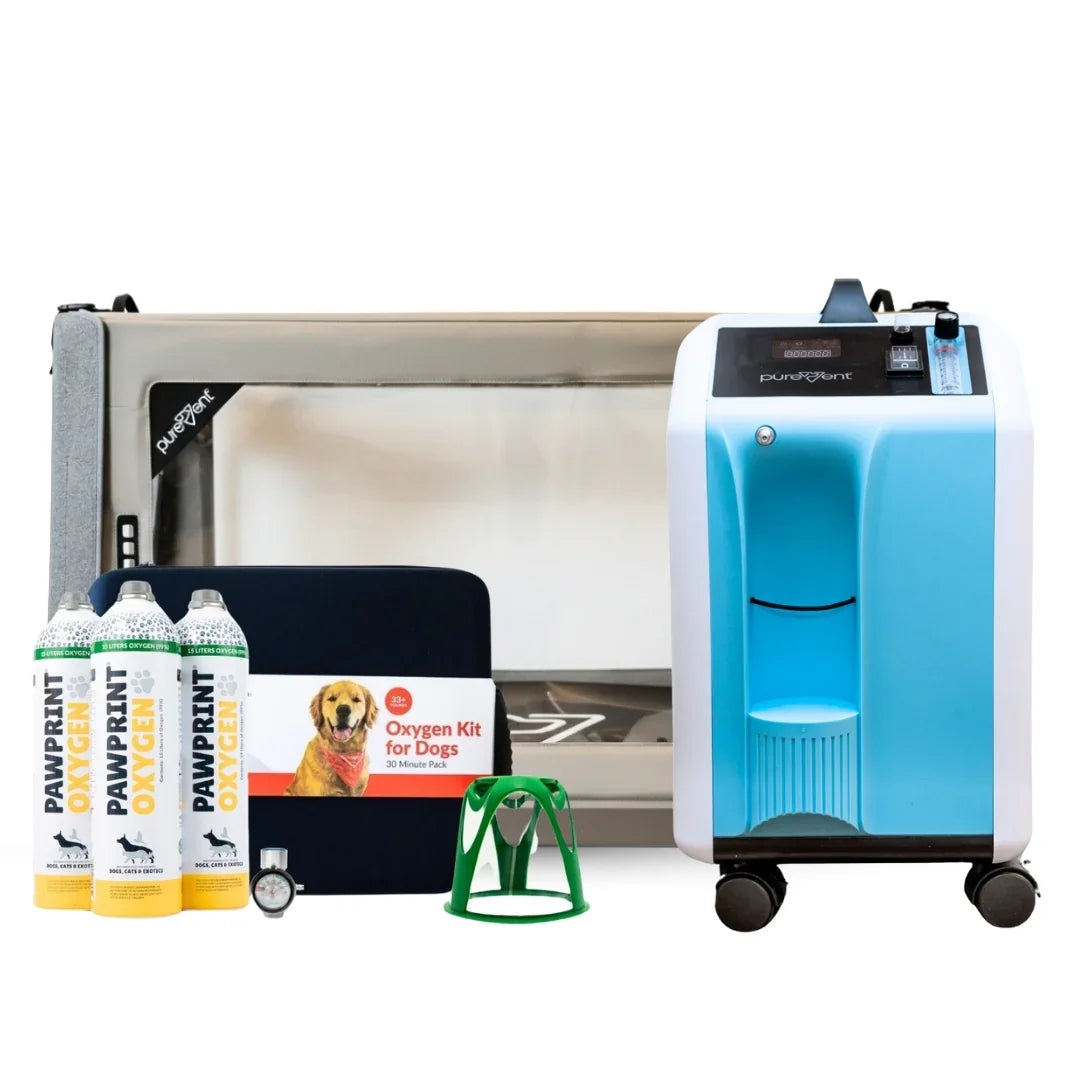
For pets already diagnosed with a cardiac or respiratory condition, some veterinarians recommend supplemental oxygen at home as part of the care plan. Oxygen does not treat the underlying condition. It reduces the work of breathing while your veterinarian manages the cause, and whether it is appropriate for your pet is their decision to make.
Heart Rate While Your Pet Is Sleeping
A sleeping dog or cat has the lowest heart rate they will show you all day, and that makes sleep the best time to take a baseline. Expect a sleeping dog to sit at or slightly below the bottom of their size range, and a sleeping cat to drop toward 120 BPM or a little under.
While your dog sleeps you may also notice the rate rising and falling in a slow cycle. That is sinus arrhythmia tracking their breathing, and in dogs it is normal. What is not normal is a sleeping pet whose heart rate stays elevated night after night, or one whose breathing quickens while they sleep. Both are worth a veterinary call, because a resting body should be showing you resting numbers.
Heart Rate in Cats
Cats are not small dogs, and their numbers reflect it. A resting adult cat runs 120 to 160 BPM, kittens 200 to 260, and both figures sit well above anything you would see in a healthy dog.
Getting an accurate count is harder. Cats are smaller, their pulse is fainter, the femoral artery is more difficult to locate through the leg, and purring interferes with a stethoscope. The chest is usually your better option, with your palm flat behind the left elbow while your cat is settled on your lap or asleep. A cat carried to the vet may read above 200 from stress alone, which is exactly why the number you take at home is more useful than the one taken in the exam room.
Cats also conceal illness far longer than dogs do, so a change in resting heart rate can be one of the earliest things you have to work with. Feline heart disease, hypertrophic cardiomyopathy in particular, is often silent until it isn't.
One sign overrides everything else on this page: a cat breathing with an open mouth, or panting, is a veterinary emergency. Cats do not pant to cool off the way dogs do. Go now. Our guide to respiratory distress in cats covers what to watch for.
Pet Heart Rate Calculator
Enter the number of heartbeats you count in 15 seconds:
Normal Heart Rate Ranges
- Cats: 120-160 BPM
- Small Dogs: 100-160 BPM
- Medium to Large Dogs: 60-100 BPM
- Puppies: 120-160 BPM
Signs of Respiratory Distress
- Rapid breathing, even while resting
- Labored or noisy breathing
- Coughing, gagging, or wheezing
- Blue or pale gums
- Open-mouth breathing, especially in cats
How to Take Your Pet's Pulse
- Chest: Place your hand on your pet's chest, just behind the left elbow.
- Inner Thigh: Feel for the pulse on the inner thigh, near the femoral artery.
- Count the beats for 15 seconds and multiply by 4 to get BPM.
- Use a stethoscope for more accurate readings.