Pet Poison Emergency · Updated 2026
Xylitol is the fastest-acting common household toxin for dogs — blood sugar can crash in minutes, and liver failure can follow days later. Here's where it hides, how little it takes, and exactly what to do if your dog gets into it.
Xylitol is a sugar substitute that's safe for humans and catastrophic for dogs. Unlike chocolate — which gives you hours — xylitol can drop your dog's blood sugar to dangerous levels inside of an hour. And unlike grapes, we know exactly what it does: it tricks the canine pancreas into dumping insulin.
This guide walks through every hiding spot in your home, what the toxic dose actually is, and the emergency steps that give your dog the best chance of a full recovery.
Quick Answer: What to Do Right Now
Xylitol causes a massive insulin spike in dogs within 10–60 minutes, leading to life-threatening low blood sugar and, in some cases, liver failure. If your dog ate anything sugar-free — gum, mints, peanut butter, toothpaste, baked goods — check the label. If xylitol (also called birch sugar) is there, call your vet or ASPCA Poison Control at (888) 426-4435 immediately. If advised, administer ReadyRESCUE™ Activated Carbon and head to the veterinarian. This is a true time-critical emergency.
Do not wait to see symptoms. Xylitol hypoglycemia can progress from normal-looking to seizure in under an hour. Every case of known or suspected exposure needs an immediate call to poison control and a drive to the clinic.
What Is Xylitol and Why Is It So Dangerous?
Xylitol is a sugar alcohol used as a low-calorie sweetener. In humans, it's harmless — it even helps prevent cavities. In dogs, it tricks the pancreas into releasing a huge burst of insulin. Blood sugar crashes within minutes. Untreated, it can be fatal.
At higher doses, xylitol also causes acute liver failure 12–72 hours later — a second, separate threat that's much harder to treat. The FDA has issued a public warning on this exact risk.
Where Xylitol Hides
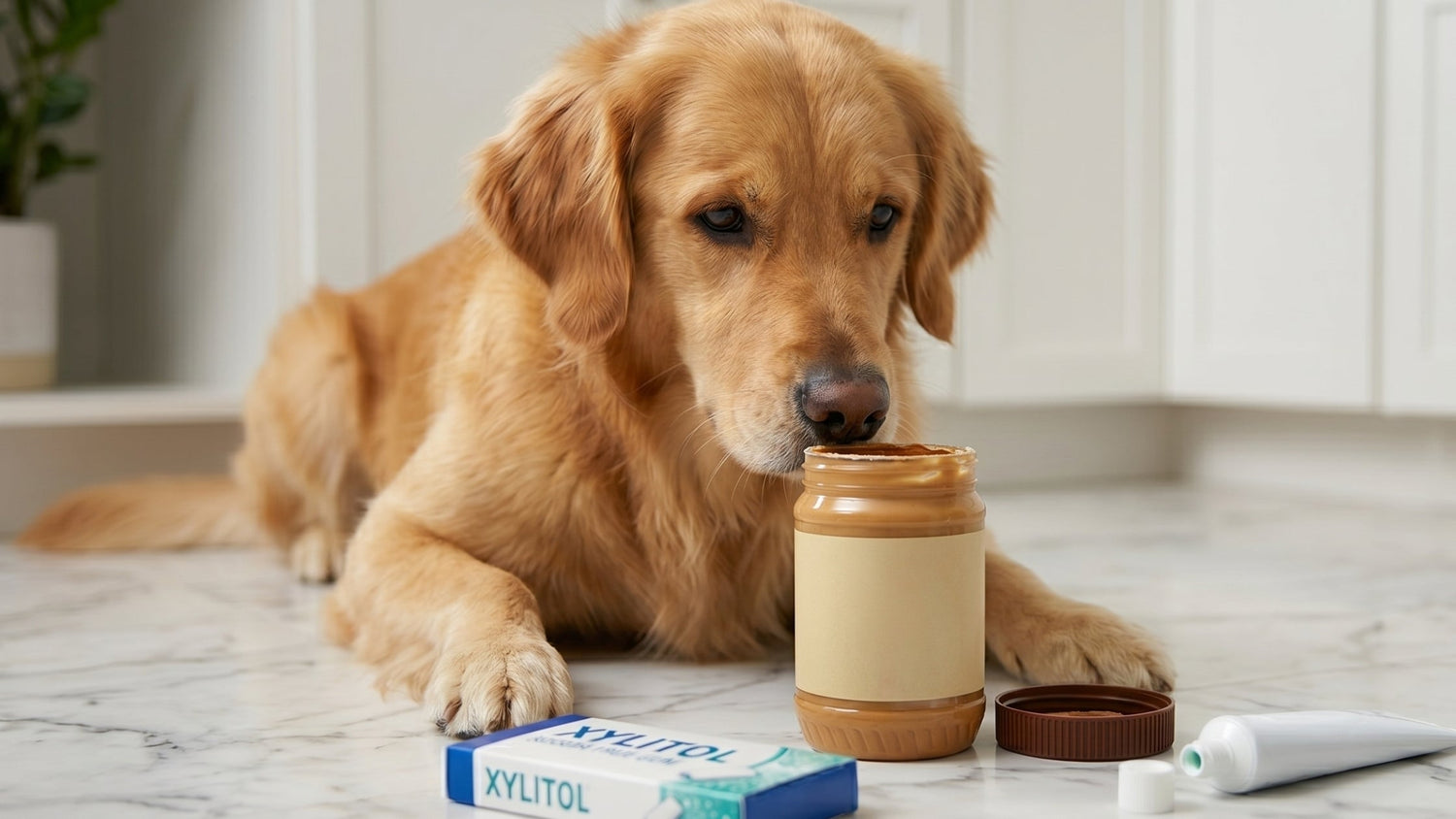
This is the part most pet owners don't realize: xylitol is in far more than gum. Always read labels on anything labeled "sugar-free," "keto," "diabetic-friendly," or "natural sweetener."
- Sugar-free chewing gum (by far the #1 cause of poisoning calls)
- Sugar-free mints and candy
- Certain brands of peanut butter — always check the label before sharing
- Sugar-free baked goods, protein bars, and cookies
- Human toothpaste and mouthwash
- Children's chewable vitamins and gummies
- Some prescription medications and nasal sprays
- Dental powders and breath fresheners
It may also be listed as birch sugar, birch sap, E967, or wood sugar on ingredient panels.
How Much Is Toxic?
Xylitol toxicity is dose-dependent. The thresholds are well established:
| Dose (per kg body weight) | Effect |
|---|---|
| 0.1 g/kg | Hypoglycemia (low blood sugar) |
| 0.5 g/kg | Acute liver failure |
Symptoms of Xylitol Poisoning
Symptoms appear fast — often within 10 to 60 minutes, though some slow-release formulations can delay onset by several hours.
Early (hypoglycemia) symptoms:
- Vomiting
- Weakness, staggering, or stumbling
- Lethargy or depression
- Trembling or shaking
- Collapse
- Seizures
Later (liver failure) symptoms, 12–72 hours in:
- Yellowing of the gums, eyes, or skin (jaundice)
- Bruising or bleeding
- Black, tarry stool
- Severe depression or coma
If your dog is showing any of these, get to an emergency vet immediately — this is not a wait-and-see situation.
What to Do If Your Dog Ate Xylitol
Step 1 — Find the packaging
Read every ingredient. Look for xylitol, birch sugar, or E967. Estimate how much your dog consumed.
Step 2 — Call poison control and your vet
Call (888) 426-4435 (ASPCA) or the Pet Poison Helpline at (855) 764-7661. Have your dog's weight and estimated dose ready.
Step 3 — Head to the vet, even if your dog seems fine
Xylitol exposure almost always requires in-clinic monitoring. Blood sugar needs to be checked every 1–2 hours, and IV dextrose may be required.
Step 4 — Activated carbon: the nuance
Historically, vets have said activated charcoal doesn't bind xylitol well. More recent formulations of high-purity activated carbon like ReadyRESCUE™ may help when xylitol is ingested alongside other toxins — common with sugar-free baked goods that also contain chocolate or raisins. For the full picture, read our guide to activated charcoal for dogs. Always check with poison control first, and treat activated carbon as a supplement to — not a replacement for — veterinary fluid therapy.
Step 5 — If your dog is lucid, offer a small snack (on vet advice only)
A small carbohydrate snack during the drive to the ER can buy time against hypoglycemia. Never force-feed a seizing or unconscious dog.
Keep xylitol-free peanut butter in the house. A tablespoon of pet-safe peanut butter can be used to deliver emergency glucose on a vet's instruction — and it's the easiest vehicle for mixing in activated carbon for other toxin exposures. Check labels every time you restock.
What Vets Will Do
- Induce vomiting if ingestion was recent
- Start IV fluids with dextrose to stabilize blood sugar
- Monitor blood glucose every 1–2 hours for 12–24 hours
- Run liver panel bloodwork at 12, 24, 48, and 72 hours
- Administer liver-protective medications (SAMe, silymarin, N-acetylcysteine) if liver values climb
Most dogs recover fully with prompt treatment. The ones who don't are almost always the ones whose owners "waited to see." See VCA's clinical reference for the full treatment protocol.
"With xylitol, the window between 'fine' and 'seizing' can be 30 minutes. The owners who catch it early are the ones who already knew what was in the grocery bag on the counter."
Prevention: Xylitol-Proof Your House
- Read labels on every sugar-free product before it enters the house
- Keep purses and backpacks off the floor (gum in a purse is the #1 source of exposure)
- Use only pet-specific toothpaste on your dog
- Check peanut butter labels every time — formulations change
- Build a complete pet poison first-aid kit with ReadyRESCUE™, a digital thermometer, and poison control numbers
Frequently Asked Questions
Is xylitol toxic to cats?
Current evidence suggests cats are far less sensitive to xylitol than dogs, but it's still not considered safe. Keep it away from all pets.
My dog ate gum three hours ago and seems fine. Am I in the clear?
No. Liver damage can appear up to 72 hours later. Call poison control regardless.
Does peanut butter contain xylitol?
Some brands do — typically the ones marketed as "low sugar" or "natural." Check the label every purchase.
What's the prognosis?
Excellent with early treatment. Dogs treated within a few hours of ingestion almost always recover completely. Delay is the killer.
The Bottom Line
Xylitol is the fastest-acting common household toxin for dogs — blood sugar can crash before you finish reading this sentence. Know the hiding spots, read labels obsessively, keep ReadyRESCUE™ Activated Carbon in your emergency kit, and never wait to see what happens. Time is blood sugar.
Minutes Matter With Xylitol
ReadyRESCUE™ is veterinary-grade activated carbon designed for at-home use. Keep it next to your pet's food — and have a plan before you ever need one.
Shop ReadyRESCUE™ → Build Your First-Aid KitRelated Resources from Pawprint Oxygen
- My Dog Ate Chocolate — What to Do Right Now
- My Dog Ate Grapes or Raisins
- Activated Charcoal for Dogs — How It Works
- The Complete Pet Poison First-Aid Kit
- Pawprint Oxygen FAQ
Sources & Further Reading
FDA — Paws Off Xylitol: It's Dangerous for Dogs
VCA Animal Hospitals — Xylitol Toxicity in Dogs
Pet Poison Helpline — Xylitol
ASPCA Animal Poison Control Center
Important: This article is educational and does not replace veterinary advice. Always contact your veterinarian or a pet poison control center when your dog ingests a toxic substance, even after giving ReadyRESCUE™.