Pet Poison Emergency · Updated 2026
Grape and raisin toxicity is unpredictable — one grape can be fatal to one dog, while another eats a handful with no ill effects. Here's what to do in the first two hours, why this toxin is so dangerous, and how activated carbon can help before you reach the vet.
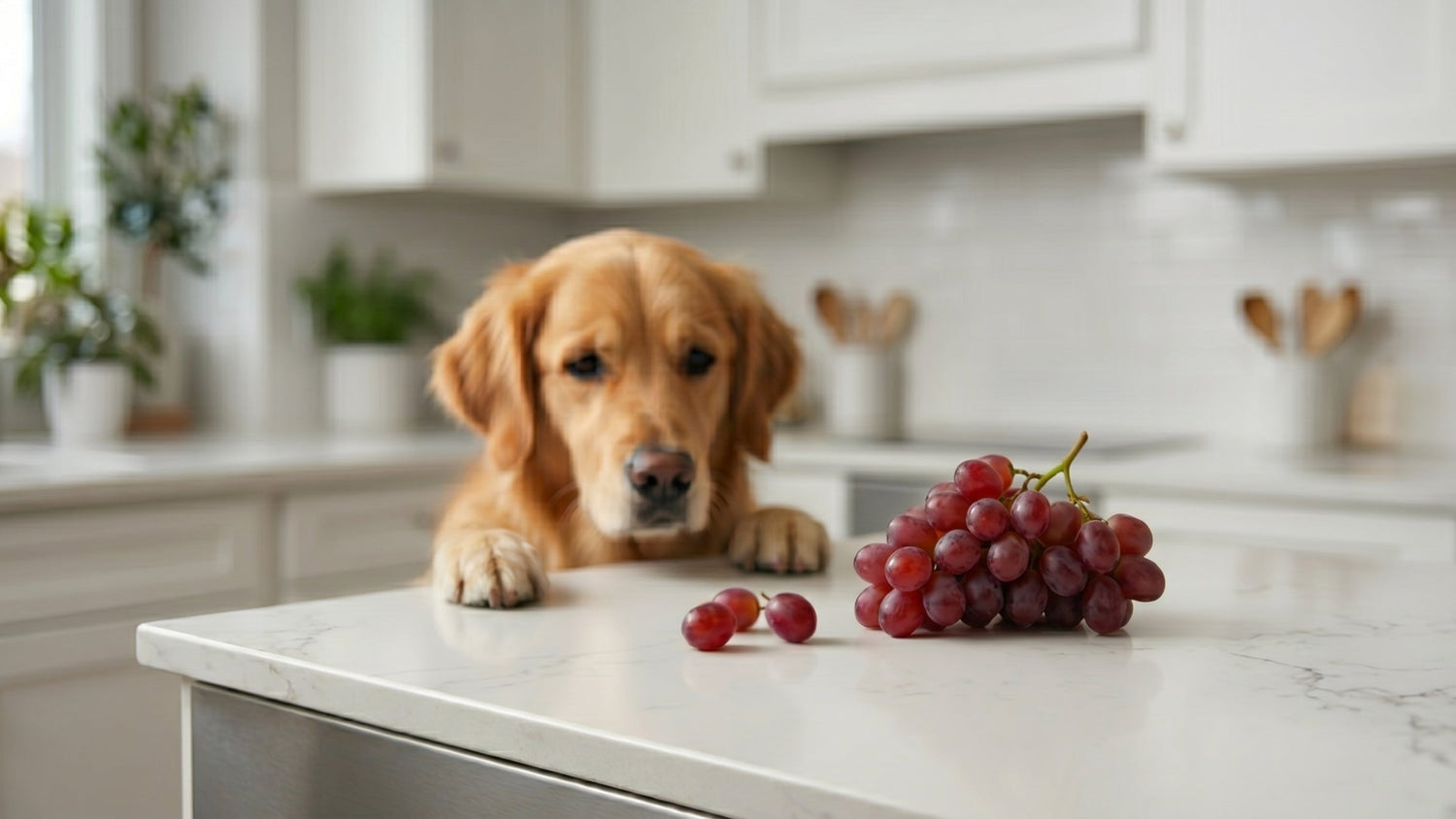
Grapes and raisins sit in a strange corner of pet toxicology. We still don't fully understand why they're toxic to dogs — but we know they can cause sudden, catastrophic kidney failure in some animals, from doses as small as a single grape. The uncertainty is exactly why every exposure has to be treated as an emergency.
This guide walks you through the first two hours after ingestion, explains why raisins are disproportionately dangerous, and shows you how at-home activated carbon can buy time while you coordinate with your veterinarian.
Quick Answer: What to Do Right Now
Grapes and raisins can cause acute kidney failure in dogs, even in tiny amounts. If your dog ate any quantity — even one grape — treat it as a medical emergency. Call your vet or the ASPCA Animal Poison Control Center at (888) 426-4435, and if recommended, administer ReadyRESCUE™ Activated Carbon to bind the toxin before it absorbs. Get to a veterinarian for IV fluid therapy as soon as possible.
There is no established "safe" dose. Cases of kidney failure have been reported from a single grape in small dogs. Don't rely on ratios or rules of thumb — call poison control and treat any ingestion as a potential emergency.
Why Grapes and Raisins Are So Dangerous
Unlike chocolate, where we know the toxic compound (theobromine), scientists still haven't identified exactly what makes grapes toxic to dogs. Recent research referenced by the AVMA points to tartaric acid and potassium bitartrate as the likely culprits. What we do know:
- Toxicity is unpredictable — some dogs eat a pound and are fine, others die from a single grape
- All forms are dangerous: fresh grapes, raisins, sultanas, currants, grape juice, wine leftovers, trail mix, cereal, and baked goods
- Concentration matters: raisins are far more toxic than grapes, ounce for ounce
- Breed, age, and individual susceptibility appear to matter — but can't be predicted in advance
Because the response varies so dramatically between individual dogs, veterinarians treat every exposure as a potential emergency.
Where Grapes and Raisins Hide
Most pet owners know about fresh grapes and snack-pack raisins — but the toxin sneaks in through dozens of other products that end up on counters and floors:
- Raisin bread, hot cross buns, scones, and cinnamon raisin bagels
- Trail mix and granola bars
- Oatmeal packets with raisins
- Fruit cake and Christmas pudding
- Wine, grape juice, and grape-flavored sodas
- Cereal with dried fruit mixed in
- Energy bites and "natural" dog treats with raisins
Symptoms of Grape Toxicity in Dogs
Symptoms typically appear within 6 to 24 hours, and kidney damage signs can take 24–72 hours to manifest:
- Vomiting (often within the first few hours)
- Diarrhea
- Loss of appetite
- Lethargy or weakness
- Abdominal pain
- Increased thirst, then decreased urination
- Dehydration
- In severe cases: kidney failure and death within 3–4 days
By the time you see decreased urination, irreversible kidney damage may already be underway. Early intervention is everything.
The First 2 Hours: What to Do
Step 1 — Remove access and count
Get your dog away from any remaining grapes or raisins. Count what's left; subtract from what was there. Check the floor, the couch, the trash.
Step 2 — Call poison control
Call (888) 426-4435 (ASPCA) or the Pet Poison Helpline at (855) 764-7661. Be ready with your dog's weight, the type and estimated amount eaten, time of ingestion, and any symptoms already present.
Step 3 — Administer activated carbon if advised
Activated carbon works by binding the toxin in the GI tract before it can absorb into the bloodstream and damage the kidneys. ReadyRESCUE™ is formulated with veterinary-grade activated carbon spheres, mixes easily into food or yogurt, and is safe to give even if you're not 100% sure your dog ingested the toxin. See our full guide to activated charcoal for dogs for how it works.
| Pet Weight | ReadyRESCUE™ Dose |
|---|---|
| 15 lbs or less | ½ vial |
| 16–30 lbs | 1 vial |
| Larger dogs | Scale per product instructions |
Step 4 — Head to the vet
Grape toxicity almost always warrants a veterinary visit for IV fluids to protect the kidneys. Activated charcoal at home buys you time — it does not replace fluid therapy.
Why the two-hour window matters: Activated carbon is most effective when given within 60 minutes of ingestion. At two hours it's still useful. After four hours, benefit drops sharply. Keeping a dose at home is how you stay inside that window while your vet's line is ringing.
What NOT to Do
- Don't wait to see if symptoms appear — kidney damage can be silent until it's too late
- Don't induce vomiting at home unless a veterinarian walks you through it
- Don't assume raisin bread or trail mix is safe in small amounts — it isn't
- Don't use human "home remedies" like milk or bread — they don't bind the toxin
Why At-Home Activated Carbon Matters
Most grape-poisoning deaths happen because treatment starts too late. Vet ERs can be 30–60 minutes away. The drive — plus intake, triage, and treatment — eats up the decontamination window. That's why a complete pet poison first-aid kit with activated carbon on hand is non-negotiable.
"For unpredictable toxins like grapes, preparation beats reaction every time. The owners who save the most kidneys are the ones who never have to Google what to do."
Other fast-acting toxins to prepare for include chocolate and xylitol.
How Vets Treat Grape Toxicity
At the clinic, expect some combination of:
- Induced vomiting (if within ~2 hours of ingestion)
- Additional activated charcoal administration
- IV fluids for 24–48 hours to flush the kidneys
- Bloodwork to monitor kidney values (BUN, creatinine, SDMA)
- Urine output monitoring
Early intervention usually leads to full recovery. Late intervention can mean permanent kidney damage or death. See VCA's clinical overview for more detail.
Frequently Asked Questions
How many grapes are toxic to a dog?
There's no safe amount. Cases of kidney failure have been reported from a single grape in small dogs.
Are all grapes equally toxic?
Evidence suggests all Vitis species — red, green, seedless, organic, peeled — carry risk. Raisins are more concentrated, so gram-for-gram they're worse.
What about cats?
Grape toxicity is less well-documented in cats, but the ASPCA treats it the same way — as a potential emergency.
Can I use activated charcoal from a pharmacy?
Pharmacy charcoal is often dosed in slurry form with sorbitol, which can cause electrolyte imbalances in pets. Veterinary-grade products like ReadyRESCUE™ are formulated specifically for pets.
What if my dog seems fine?
"Seeming fine" is normal in the first 12 hours. Call poison control anyway.
The Bottom Line
Grapes and raisins punch above their weight. They're small, they're everywhere, and their toxicity is unpredictable — which makes preparation non-negotiable. Keep ReadyRESCUE™ Activated Carbon in your pet first-aid kit, save poison control in your contacts, and never assume "just one" is safe.
One Grape Shouldn't Be a Life-or-Death Gamble
Keep ReadyRESCUE™ in your kitchen drawer so you never have to wonder whether "just a couple" were too many. Veterinary-grade activated carbon, ready when you need it.
Shop ReadyRESCUE™ → Build Your First-Aid KitRelated Resources from Pawprint Oxygen
- My Dog Ate Chocolate — What to Do Right Now
- Xylitol Poisoning in Dogs
- Activated Charcoal for Dogs — How It Works
- The Complete Pet Poison First-Aid Kit
- Pawprint Oxygen FAQ
Sources & Further Reading
AVMA — Household Hazards for Pets
VCA Animal Hospitals — Grape & Raisin Toxicity in Dogs
Pet Poison Helpline — Grapes & Raisins
ASPCA Animal Poison Control Center
Important: This article is educational and does not replace veterinary advice. Always contact your veterinarian or a pet poison control center when your dog ingests a toxic substance, even after giving ReadyRESCUE™.